Yorkshire Terrier Training Tips: The Complete Guide to Training Your Yorkie
Yorkshire Terriers are intelligent, spirited little dogs with personalities far bigger than their small size. But if you’ve ever tried to train one, you’ll know that their stubborn streak can be a challenge. The good news? With the right approach, your Yorkie can be just as well-behaved as any other breed — in fact, their intelligence makes them highly trainable when you know how to work with them.
This guide covers everything you need to know about training your Yorkshire Terrier, from puppy basics to solving common behavioural issues like excessive barking and stubbornness.
Understanding Your Yorkie’s Temperament
Before you start training, it helps to understand what makes your Yorkie tick. Originally bred as ratting dogs in Yorkshire textile mills, these little terriers are brave, confident, and independent. They were bred to make decisions on their own — which means they sometimes think they know better than you do!
Key traits that affect training:
- High intelligence — Yorkies learn quickly, but they also get bored easily
- Stubbornness — They may deliberately ignore commands if they don’t see the point
- Big dog attitude — Your Yorkie doesn’t know it’s small and may try to dominate
- Sensitivity — Harsh corrections can backfire; they respond much better to positive reinforcement
The single most important training principle for Yorkies is positive reinforcement. Reward good behaviour with treats, praise, or playtime, and your Yorkie will eagerly repeat it. Punishment or scolding, on the other hand, can make them anxious or resentful. Dog training experts all agree that reward-based methods produce the best long-term results for small breeds.
Are Yorkies Difficult to Train?
This is the most common question new Yorkie owners ask, and the answer is: not if you do it right. Yorkies are ranked 27th out of 138 breeds in Stanley Coren’s intelligence rankings — above average! They pick up new commands in 15-25 repetitions and obey the first command around 70% of the time.
What makes Yorkies seem difficult is their independent nature. A Yorkie won’t obey just to please you — they need to understand what’s in it for them. That’s why high-value treats, enthusiasm, and consistency are non-negotiable. Some owners find this breed hard to train at first, but with the right training methods, they become eager students.
Start training early. The sooner you begin, the easier it is. Eight weeks old is the perfect age to start basic training with your Yorkie puppy. Following a clear training plan from day one prevents bad habits from forming.
Basic Obedience Commands Every Yorkie Should Know
Start with these five foundation commands. Use a training plan that builds each skill step by step, and always carry small treats during training sessions.
Sit
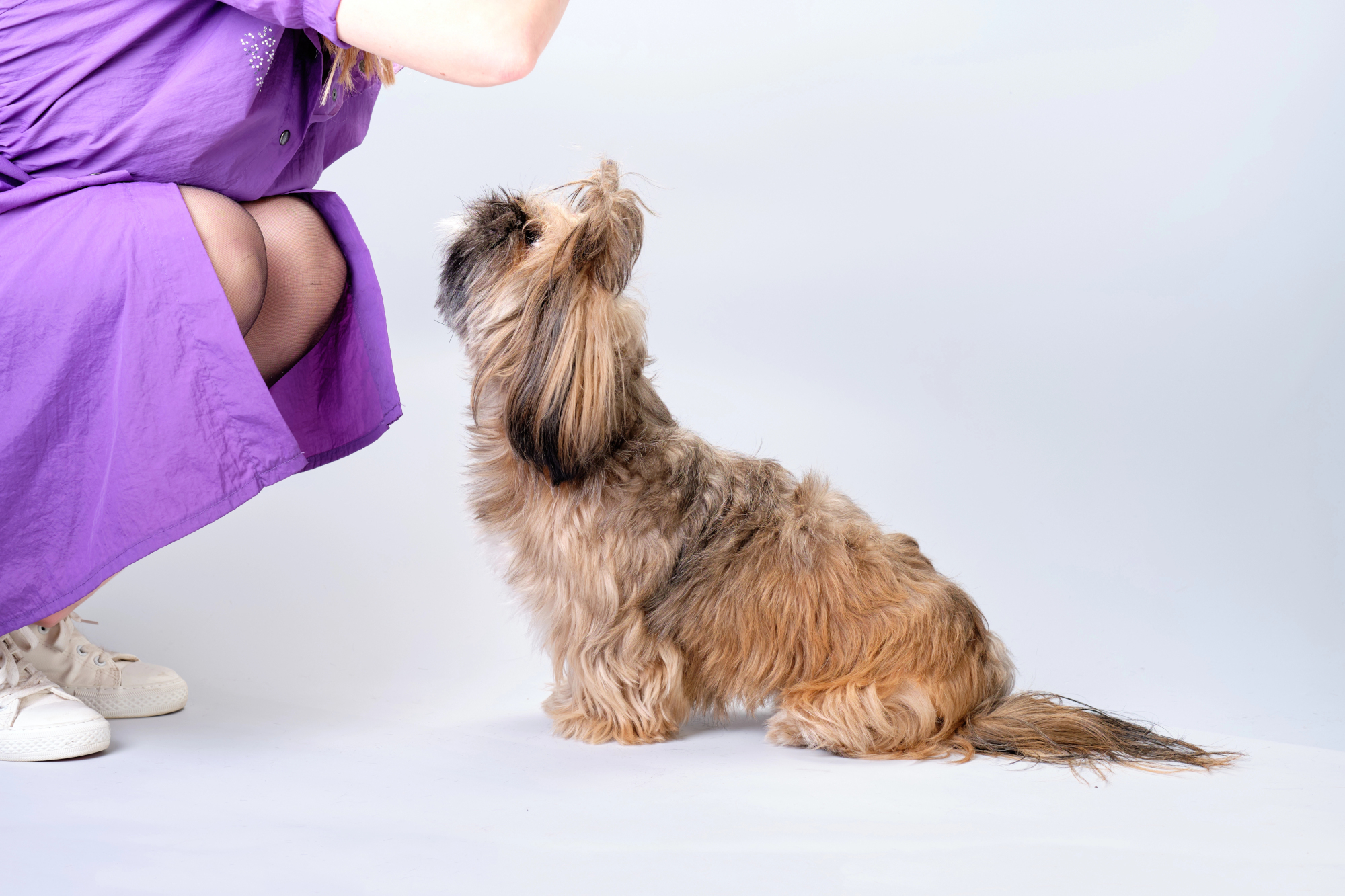
Hold a treat above your Yorkie’s nose and slowly move it back over their head. As their head follows the treat, their bottom will naturally lower. The moment they sit, say “Sit!” and give them the treat with lots of praise.
Stay
Once your Yorkie has mastered “Sit,” ask them to sit, then hold your palm out and say “Stay.” Take one step back. If they stay, return and reward. Gradually increase the distance and duration.
Come
This command could save your Yorkie’s life. Start in a quiet room, say your dog’s name followed by “Come!” in an excited voice, and reward enthusiastically when they reach you. Practice with increasing distractions.
Down
With your Yorkie in a sit position, hold a treat in your closed fist and lower it to the floor. Your Yorkie should follow the treat down. The moment their elbows touch the ground, say “Down!” and reward.
Leave It
Place a treat in your closed fist and let your Yorkie sniff it. Say “Leave it” and wait until they stop trying to get it. The instant they pull back, reward them with a different treat from your other hand. This is invaluable for preventing them from eating things they shouldn’t.
Keep training sessions short — 5 to 10 minutes maximum — and always end on a positive note. Yorkies have short attention spans, and a frustrated Yorkie will simply switch off. Many Yorkie owners find that two or three short sessions per day work better than one long session.
House Training Your Yorkie: The Small Breed Challenge
House training a Yorkie can be challenging because their tiny bladders mean they need to go out more frequently. But with consistency, your Yorkie can be reliably house trained.
The key to success: a strict schedule.
Take your Yorkie puppy out:
- First thing in the morning
- After every meal (within 15-20 minutes)
- After naps
- After play sessions
- Every 2-3 hours during the day
- Right before bedtime
Choose a specific spot outside and use a command like “Potty!” or “Go now!” every time. When they go, reward immediately with a treat and praise. Potty pads can be useful as a backup when going outside isn’t possible, but try to transition to outdoor elimination as soon as possible.
Crate training is a powerful ally in house training. Dogs naturally avoid soiling their sleeping area, so a properly sized crate (just big enough for your Yorkie to stand, turn around, and lie down) helps them learn bladder control.
Expect accidents — they’re part of the process. Never punish your Yorkie for an accident you didn’t catch in the act; they won’t connect the punishment to the behaviour. Instead, clean thoroughly with an enzymatic cleaner to remove all scent markers.
Crate Training Your Yorkie
Many owners feel guilty about crate training, but for Yorkies, a crate becomes a safe den — their own private space. Crate training is also essential for travel, vet visits, and keeping your Yorkie safe when you can’t supervise.
How to crate train your Yorkie:
- Make the crate inviting with a soft bed and toys
2. Leave the door open and let your Yorkie explore on their own
3. Feed meals inside the crate with the door open
4. Gradually close the door for short periods while you’re present
5. Extend the time your Yorkie spends in the crate with the door closed
The crate should never be used as punishment. When used correctly, your Yorkie will see it as a cosy retreat. Proper crate training also gives you a useful management tool for puppy proofing your home — when you can’t supervise, the crate keeps your Yorkie safe.
Socialization: Building a Confident Small Dog
Small breeds like Yorkies have a reputation for being yappy or anxious, but that’s often a result of poor socialization rather than genetics. Early socialization is critical.
Between 3 and 16 weeks of age, expose your Yorkie puppy to:
- Different people (men, women, children, people in hats)
- Other friendly, vaccinated dogs
- Various surfaces (grass, concrete, carpet, stairs)
- Different sounds (traffic, vacuum, doorbell)
- Handling (paws, ears, mouth — for future grooming and vet visits)
The goal is positive associations. Each new experience should be accompanied by treats and praise. If your Yorkie seems scared, don’t force them — go at their pace and reward bravery.
How to Stop Your Yorkie From Barking Excessively
Yorkies are alert dogs with a terrier instinct to sound the alarm at anything unusual. While you can’t eliminate barking entirely, you can manage it.
Common causes of excessive barking:
- Territorial alert — Someone at the door, a noise outside
- Attention seeking — Your Yorkie has learned that barking gets your attention
- Boredom — Not enough mental stimulation or physical exercise
- Separation anxiety — Distress when left alone
Solutions:
For alert barking, teach the “Quiet” command. When your Yorkie barks, calmly say “Quiet.” The moment they stop — even for a second — reward. Gradually increase the quiet duration required before rewarding.
For attention-seeking barking, the most effective solution is to ignore it completely. No eye contact, no touch, no words. The moment your Yorkie is quiet, give attention. They’ll quickly learn that silence works better than barking.
For boredom barking, make sure your Yorkie gets enough exercise and mental stimulation. A tired Yorkie is a quiet Yorkie. Puzzle toys, hide-and-seek games, and short training sessions help burn mental energy.
Tip: Never yell at your Yorkie to stop barking. To a Yorkie, it sounds like you’re joining in, which can encourage more barking.
What Not To Do When Training a Yorkie
There are some common mistakes that can derail your Yorkie’s training:
Don’t use harsh corrections. Yorkies are sensitive and can become fearful or aggressive if handled roughly. Positive reinforcement is far more effective.
Don’t be inconsistent. If you let your Yorkie on the sofa sometimes but not others, you’ll confuse them. Consistency across all family members is essential.
Don’t skip the small stuff. Training opportunities happen all day — waiting at doors, sitting before meals, staying during grooming. Use them. These little moments reinforce proper training throughout the day.
Don’t give up. Some Yorkies take longer to train than others. If something isn’t working, try a different approach, shorter sessions, or higher-value treats. Patience and the right training methods always pay off.
How Much Exercise Does a Yorkie Need?
Despite their small size, Yorkies are full of energy and need regular activity. Aim for 30-45 minutes of activity per day, split into two sessions.
Good exercise options for Yorkies:
- Short walks (they have tiny legs — adjust your pace)
- Indoor fetch in a hallway
- Hide and seek with treats
- Puzzle toys and treat dispensers
- Dog agility (Yorkies excel at this!)
Exercise before training sessions helps your Yorkie focus better — a calm dog learns more effectively than one bursting with pent-up energy.
At What Age Should I Start Training My Yorkie Puppy?
You can start training the day you bring your Yorkie puppy home at 8 weeks old. At this age, focus on:
- Name recognition
- Potty schedule
- Crate introduction
- Handling (paws, ears, mouth)
- Bite inhibition (teaching soft mouth)
Formal obedience training can begin around 10-12 weeks. Yorkie puppy classes are excellent for both training and socialization. Use a leash and harness rather than a collar to protect your Yorkie’s delicate neck during early walks.
By 6 months, your Yorkie should reliably know sit, stay, come, and down — though you’ll need to practice regularly to maintain these skills.
Common Yorkie Behaviour Problems (And How to Fix Them)
Puppy Biting and Nipping
Puppy biting is very common in Yorkies. They explore the world with their mouths, and during teething (around 4–6 months) the urge to chew is even stronger. Most Yorkies grow out of this as they get older, but in the meantime:
- Redirect — when they bite, immediately offer a chew toy instead
- Yelp — a high-pitched yelp (like another puppy would make) can startle them and teach bite inhibition
- Ignore — if they bite during play, stop playing and turn away for 30 seconds
- Never punish physically — it can damage trust and make biting worse
Consistency is key. With patience, most Yorkies outgrow puppy biting by the time their adult teeth come in.
Leash Aggression: Biting the Lead and Pulling
If your Yorkie goes crazy at the sight of the lead — biting it, pulling, and barking — this is usually over-excitement rather than aggression. Try these approaches:
- Desensitise to the lead — leave it out where they can see it without reacting, reward calm behaviour
- Use a harness instead of a collar (safer for Yorkies prone to tracheal collapse)
- Stop moving when they pull or bite the lead — only move forward again when they are calm
- Practice indoors first in a low-distraction environment
Humping Behaviour
Yorkie pups can begin humping at a very young age — sometimes as young as 2 months. It is not always sexual; it can be due to excitement, over-stimulation, or a desire to establish dominance. If your Yorkie is over 6 months and not yet neutered, neutering can help reduce the behaviour. For puppies, redirecting to a toy or separating them from whatever triggers the behaviour is the best approach. Humping usually decreases with age and consistent training.
Jealousy and Possessiveness
It is not uncommon for a Yorkie to become jealous or possessive, especially when a new dog joins the household. Signs include growling, snapping, or trying to get between you and the other dog. To manage this:
- Give equal attention — do not favour one dog over the other
- Feed separately to avoid resource guarding
- Use positive associations — when the other dog is near, give treats and praise
- Create separate spaces where each dog can have time away
In most cases, with time and consistent handling, Yorkies learn to share their home peacefully.
When Do Yorkies Start Barking?
Many Yorkies are late bloomers when it comes to barking. Some do not find their vocal cords until 4–6 months old, and some may even be a year old before they start barking regularly. Once they do start, they rarely stop! Yorkies are known for being alert and vocal dogs. If your 4-month-old Yorkie is not barking yet, that is completely normal — they will find their voice in their own time.
Recommended Training Products for Your Yorkie
Having the right tools makes training your Yorkshire Terrier much easier. Here are our top product recommendations to help you and your Yorkie succeed.
Best Training Treats for Yorkies
Because Yorkies are so small, you need training treats that are tiny, low-calorie, and highly palatable. Here are the top-rated options:
- Pupford Freeze-Dried Beef Liver Training Treats — Less than 1 calorie per treat, single-ingredient, perfect for extended training sessions without weight gain.
Shop on Amazon → - Zuke’s Mini Naturals Dog Training Treats — Soft, bite-sized, under 3 calories each, and have an intense aroma that keeps Yorkies focused.
Shop on Amazon → - Wellness Core Tiny Trainers Tender Lamb & Apples — Specifically designed for toy breeds with a tender, easy-to-chew texture. Grain-free with 3 calories each.
Shop on Amazon → - PureBites Mini Trainers Freeze-Dried Chicken Breast — 100% pure chicken breast, ideal for Yorkies with sensitive stomachs or allergies.
Shop on Amazon →
As an Amazon Associate, we earn from qualifying purchases. This does not affect the price you pay.
Frequently Asked Questions
Are Yorkies easy to train?
Yorkies are intelligent and quick to learn, but their independent nature means they need motivation. With positive reinforcement and consistency, they train well. Their intelligence ranks above average among dog breeds.
How do you discipline a Yorkie effectively?
The most effective approach is to ignore unwanted behaviour and reward wanted behaviour. Time-outs (a few minutes in a quiet room) can help with persistent issues. Never use physical punishment.
What are the signs of a happy Yorkie?
A happy Yorkie wags their tail (often their whole body), has relaxed ears and eyes, is playful and curious, eats well, sleeps soundly, and seeks interaction with you without being demanding.
Why is my Yorkie so stubborn?
Yorkies were bred to work independently, making decisions on their own. This trait translates to stubbornness in training. The solution is to make training more valuable to them — higher-value treats, more enthusiasm, and shorter, more engaging sessions.
How do I stop my Yorkie from barking at everything?
Address the underlying cause. Increase exercise and mental stimulation, teach the “Quiet” command, and manage the environment (close curtains, use white noise) to reduce triggers. For severe cases, consult a professional trainer.
Your Yorkie’s Training Journey
Training a Yorkshire Terrier takes patience, consistency, and a good sense of humour. Your Yorkie will test boundaries, find creative ways to get what they want, and occasionally drive you crazy — but that’s part of their charm.
The rewards are worth it. A well-trained Yorkie is a confident, happy companion who can go anywhere with you, greet guests politely, and be a joy to live with instead of a tiny tyrant ruling the household.
Remember: training is a lifelong process. Keep training sessions fun, keep rewards coming, and keep building that bond with your Yorkie. The time you invest now will pay off in years of wonderful companionship.
Ready to take your Yorkie’s training to the next level? Our comprehensive ebook, Training Yorkshire Terriers, covers everything from puppy basics to advanced commands, problem behaviours, and tricks. With step-by-step instructions, troubleshooting guides, and expert tips from years of Yorkie experience, it’s the ultimate resource for any Yorkshire Terrier owner.
👉 Get the Training Yorkshire Terriers ebook here →
About Yorkies has been helping Yorkshire Terrier owners since 2006. We’re dedicated to providing expert, practical advice for Yorkie lovers everywhere.
Related Reading
- Common Yorkie Behavior Problems — Fix biting, leash aggression, humping, and jealousy
- Leash Training for Yorkies — Harness and leash walking tips
- Clicker Training — Effective positive reinforcement methods
- Basic Dog Training Commands — Essential cues every Yorkie should know
- Housetraining Guide — Potty training your Yorkie
- Best Dog Crates for Small Dogs — Crate training recommendations
Leave a Reply